


For years, Platelet-Rich Plasma (PRP) has been hailed as a “wonder treatment” for knee osteoarthritis (OA). Yet, many patients walk into our clinics sharing a similar story: “I tried PRP elsewhere, and it didn’t really work.” “My orthopaedic surgeon told me that PRP doesn’t work”
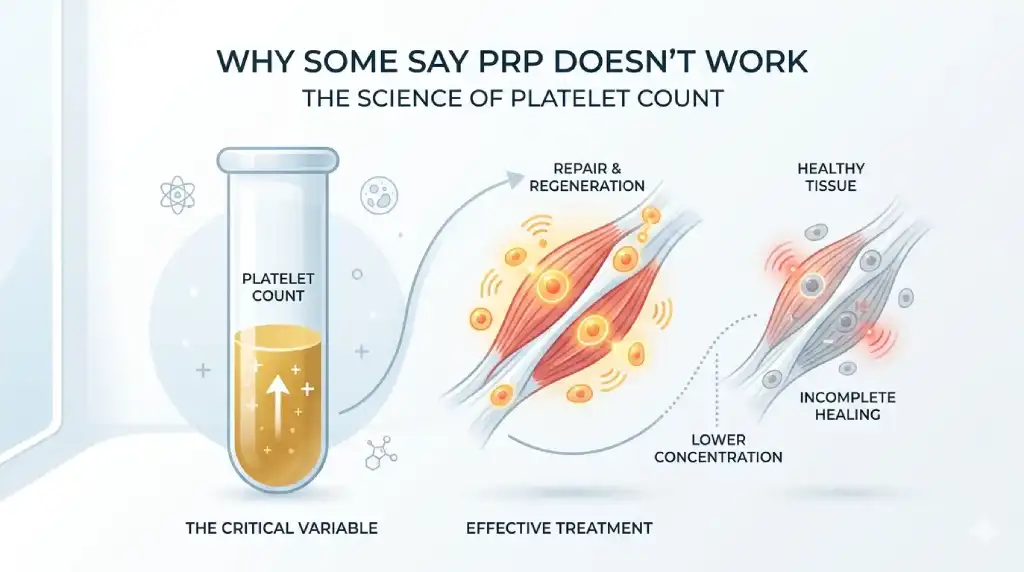
Recent landmark research from 2025 and 2026 has finally uncovered the “missing link” in regenerative medicine. It turns out that PRP is not a one-size-fits-all product. The secret to long-lasting relief isn’t just getting PRP—it’s the dosage.
The 10 Billion Platelet Threshold
A comprehensive meta-analysis published in Arthroscopy (2025) and updated reviews in early 2026 have fundamentally changed how we approach joint healing. The research examined thousands of patients and reached a definitive conclusion:
Clinical success in treating knee osteoarthritis is directly tied to the total number of platelets delivered.
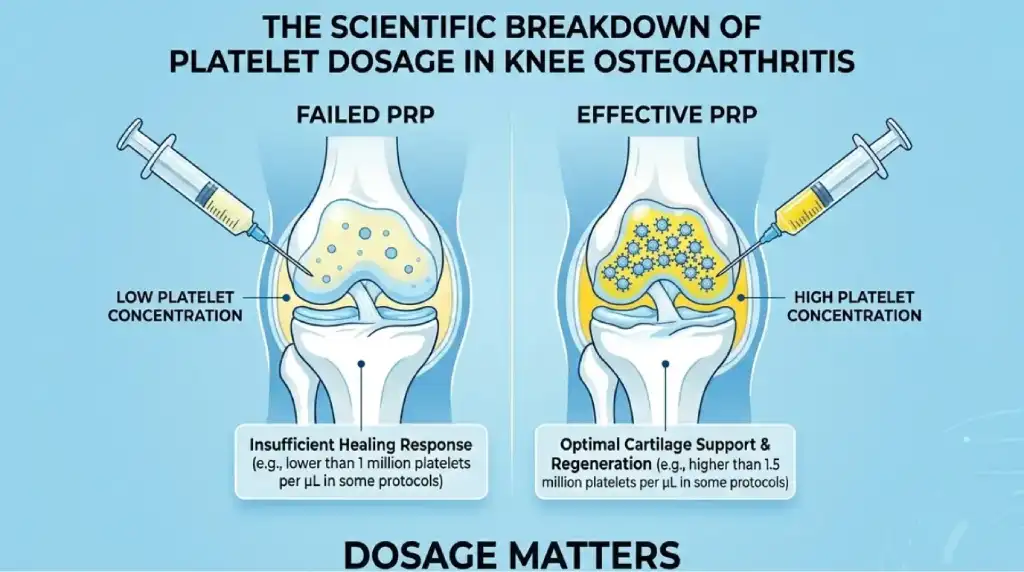
Studies show that “High-Dose” PRP—defined as a concentration delivering 10 billion or more platelets in a single treatment—provides significantly superior outcomes in:
- WOMAC Scores:Drastic improvements in pain, stiffness, and physical function.
- Longevity:Benefits that remain stable for over 12 months, whereas low-dose treatments often fail by the 6-month mark.
- Cartilage Health:Enhanced protective effects on the joint environment compared to standard Hyaluronic Acid (HA).
The Problem with "Standard" PRP
Most clinics use simple, automated “bedside” centrifuges. While convenient, these often produce a “low-dose” PRP that may only contain 1 to 3 billion platelets. While this might offer temporary relief, it often falls below the therapeutic threshold required to “flip the switch” on cellular repair.
Why Indo British Advanced Pain Clinics (IBAP) is Different
At Indo British Advanced Pain Clinics, we follow the rigorous standards for biologic processing. We don’t just “spin and inject.” Our protocol focuses on Precision Biologics:
- Custom Concentration:We calculate the exact volume needed to reach the 10 billion platelet goal.
- Purity Matters:We minimize red blood cells and neutrophils, which can cause unnecessary inflammation and pain after the injection.
- Image Guidance: Every injection is performed under high-definition ultrasound or fluoroscopy to ensure the high-dose concentrate is delivered exactly where the damage is—not just near it.
The Evidence: PRP vs. Hyaluronic Acid
While Hyaluronic Acid (HA) injection into joints acts as a lubricant, it doesn’t address the underlying biological environment. The 2026 data confirms that PRP outperforms HA across all major metrics at the one-year mark. While HA “greases the gears,” High-Dose PRP works to modulate the environment, reducing the “toxic” inflammatory chemicals that eat away at your cartilage.
Is High-Dose PRP Right for You?
If you have mild to moderate knee osteoarthritis and want to avoid or delay surgery, the science is clear: Dosage is the difference. Don’t settle for “standard” when you can have “precision.”
Ready to experience the IBAP difference?
Schedule a consultation at our Banjara Hills or Madeenaguda clinics to discuss a personalized regenerative plan.
“Not Just PRP—Precision Biologics. Heal Your Joints from Within.”
Scientific References
- Berrigan, W. A., et al. (2025). “A Greater Platelet Dose May Yield Better Clinical Outcomes for Platelet-Rich Plasma in the Treatment of Knee Osteoarthritis: A Systematic Review.” Arthroscopy: The Journal of Arthroscopic & Related Surgery.
- Qiao, et al. (2026). “Efficacy and Safety of CSC, HA, and PRP and Combination Therapy for Knee OA: A Systematic Review and Network Meta-analysis.” International Journal of Clinical Medicine.
- Berrigan, W., et al. (2024). “The Effect of Platelet Dose on Outcomes after Platelet Rich Plasma Injections for Musculoskeletal Conditions: A Systematic Review and Meta-Analysis.” Current Reviews in Musculoskeletal Medicine.
- Bagheri, et al. (2025). “Platelet-rich plasma compared to viscosupplementation in the treatment of knee OA: A 12-month follow-up meta-analysis.”