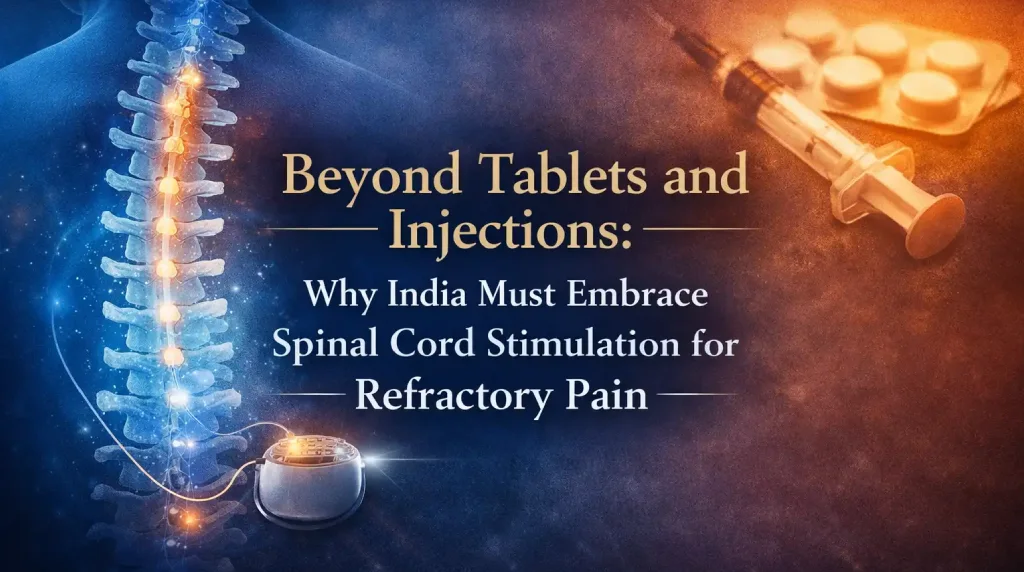
India is at a point where continuing to rely on “conventional medical management (CMM)” alone for chronic refractory neuropathic pain is increasingly out of step with the evidence; spinal cord stimulation (SCS) and related neuromodulation options now have strong long‑term data, while CMM arms in modern trials.
Is It Time for India to Embrace Spinal Cord Stimulation?
For thousands of Indians living with chronic back, leg, or nerve pain, the story is depressingly familiar: years of tablets, injections, physiotherapy, and even surgery, yet the pain keeps coming back.
Two major pieces of recent evidence now tell us something uncomfortable but important—for the kind of patients who qualify for neurostimulation, conventional medical management (CMM) alone almost never delivers meaningful, lasting relief.
At the same time, a 2023 systematic review of high‑quality, long‑term randomized trials shows that modern neurostimulation (including SCS and DRG stimulation) can provide durable pain relief and functional gains when used in the right patients.
Taken together, these data raise a simple but powerful question for our country:
Is it time for India to fully embrace spinal cord stimulation for chronic refractory pain?
What the newest evidence actually says
A 2023 systematic review in Neuromodulation pooled long‑term, high‑quality randomized controlled trials of neurostimulation for chronic pain—focusing on conditions like failed back surgery syndrome, persistent spinal pain, complex regional pain syndrome (CRPS), and neuropathic limb pain.
Across modalities, the authors found that neurostimulation consistently outperformed CMM in pain relief, function, and quality of life, with benefits sustained at one year and beyond in appropriately selected patients
More recently, a 2024–2025 meta‑analysis looked specifically at the CMM arms of SCS trials—essentially asking: What happens if SCS‑eligible patients simply continue with medications, injections, and conservative care?
The answer was sobering : pain scores in the CMM‑only groups showed little or no clinically meaningful improvement over time, despite decades of “best available” medical therapy.
In other words :
- CMM alone seldom changes the trajectory for SCS‑eligible refractory pain.
- Neurostimulation adds real, durable benefit when introduced at the right stage.
SCS today : not your old “tingling box”
Early SCS devices were simple, paresthesia‑based systems with fixed, low‑frequency stimulation, often producing uncomfortable tingling and variable day‑to‑day relief.
Modern systems are vastly more sophisticated, offering :
- Closed‑loop SCS that measures evoked compound action potentials (ECAPs) in real time and automatically adjusts output to keep spinal cord activation in a personalized therapeutic window.
- High‑frequency 10 kHz stimulation (HF10) that provides pain relief without paresthesias and has been shown in randomized controlled trials to be superior to traditional low‑frequency SCS for chronic back and leg pain.
- Advanced waveforms such as differential target multiplexed (DTM) stimulation, burst stimulation, and combinations of low‑ and high‑frequency signals that aim to modulate both neuronal and glial pain pathways.
In a pivotal closed‑loop SCS study, about 79% of patients achieved at least 50% pain relief at 24 months, significantly better than open‑loop SCS, with parallel gains in mood, sleep, and quality of life.
Another long‑term closed‑loop series reported mean pain reductions of 72% at 12 months, with over 76% of patients achieving at least 50% relief and more than half reaching ≥80% relief, alongside marked improvements in disability and sleep.
This is a very different proposition from “one more injection” or “a stronger tablet.”
DRG stimulation : precision neuromodulation for focal neuropathic pain
Beyond traditional dorsal column SCS, dorsal root ganglion (DRG) stimulation targets the sensory cell bodies at the level of the affected root, offering extremely focal neuromodulation.
In the ACCURATE randomized trial and subsequent systematic review, about 74% of DRG patients achieved ≥50% pain relief versus 51% with conventional SCS at 3 months for conditions like CRPS and causalgia, with sustained benefit at 12 months.
Evidence now supports DRG stimulation as :
- A more effective option than traditional SCS for focal CRPS and causalgia.
- A promising therapy for pelvic, groin, post‑amputation, and other regional neuropathic pains, albeit with lower‑quality evidence that is steadily improving.
For Indian patients with localized, intractable neuropathic pain, DRG stimulation represents a level of precision we simply could not offer a decade ago.
The Indian picture : devices and expertise are already here
SCS is no longer a purely “Western” technology. India has already seen implantation of state‑of‑the‑art, MRI‑conditional, rechargeable systems such as Medtronic’s Intellis platform in tertiary centres in Mumbai and other metros.
Major hospital chains and pain centres describe SCS as an established option for :
- Failed back surgery syndrome and persistent spinal pain.
- CRPS and other severe neuropathic limb pains.
- Painful diabetic neuropathy and cancer‑related neuropathic pain in selected cases.ipscindia+3
Patient‑facing materials from Indian centres already highlight SCS as standard of care after failure of conservative treatments, emphasizing trial stimulation, reversibility, and day‑care style implantation.indianneurosurgery+2 International manufacturers market SCS in India as a proven long‑term therapy that can reduce opioid consumption and improve daily functioning, supported by multiple clinical studies.
The technology, the hardware, and the implantation expertise are here; what is missing is scale and timely referral.
Who should India be offering SCS to?
Based on the 2023 systematic review and current guidelines, ideal SCS/neuromodulation candidates are patients with:apollohospitals+4
- Persistent spinal pain / failed back surgery syndrome : chronic back and leg pain despite technically adequate surgery and optimized conservative care.
- Radicular neuropathic pain not amenable to or not relieved by further decompression.
- CRPS and causalgia : particularly for DRG stimulation when the pain is topographically well‑pmc.ncbi.nlm.nih+1
- Painful diabetic neuropathy and other chronic neuropathic limb pains where medications have failed or are poorly tolerated.indianneurosurgery+2
Crucially, the 2024–2025 CMM meta‑analysis suggests that keeping such patients in a prolonged cycle of drugs, injections, and repeated “minor procedures” without offering neuromodulation may simply be prolonging suffering with little gain.
Common concerns : cost, safety, and “what if it doesn’t work?”
Modern SCS systems are fully reversible : patients undergo a trial first, usually of a few days, and only proceed to a full implant if they experience at least 50% pain relief and functional improvement.
Large RCTs and long‑term series show favourable safety profiles, with complications typically related to lead migration or infection, which are manageable with established protocols.
While the upfront device cost can be significant by Indian standards, international and manufacturer data suggest that SCS can be cost‑effective over time by reducing hospitalizations, repeat surgeries, and long‑term medication burden—especially opioids.
As local volumes increase and more centres obtain experience, package pricing, financing, and insurance coverage are likely to improve, just as we have seen with cardiac stents, joint replacements, and deep brain stimulation.
A new standard for chronic refractory pain in India
The combination of :
- A 2023 systematic review confirming durable benefit of neurostimulation in carefully selected chronic pain syndromes.
- A 2024–2025 meta‑analysis showing minimal meaningful improvement with continued CMM alone in SCS‑eligible patients.
- And rapid advances in closed‑loop, high‑frequency, DRG‑targeted and other next‑generation SCS technologies with very high responder rates and quality‑of‑life gains.
makes it increasingly difficult to justify CMM‑only care as the “gold‑standard” for India’s chronic refractory neuropathic pain population.
For Indian pain physicians, neurosurgeons, orthopaedic spine surgeons, and diabetologists, the message is clear:
“When chronic neuropathic pain stops responding to tablets, injections, and surgery, it is time to talk about neuromodulation—not after another lost decade.”
For patients and families, the question to ask is simple:
“Have we explored spinal cord or DRG stimulation with a specialist trained in neuromodulation?”
If the answer is no—and the pain is still ruling the patient’s life—then yes, it is time for India to embrace spinal cord stimulation.