
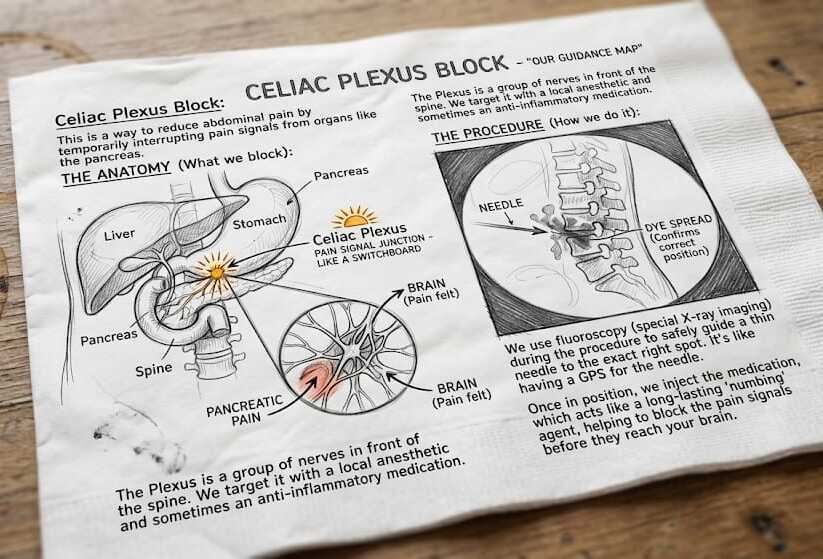
dense network of nerves located deep in your abdomen, behind your stomach. These nerves carry pain signals from organs like the pancreas, liver, gallbladder, stomach, and intestines up to your brain.
A celiac plexus block is a procedure where a doctor injects medication around this nerve switchboard to “turn off” or “turn down” the pain signals. It’s like flipping a circuit breaker to stop the flow of electricity.
Why Would Someone Need This Procedure?
This procedure is typically considered when oral pain medications (like opioids) are not working well enough, or are causing severe side effects like constipation, nausea, or confusion. It’s a targeted way to manage pain at its source.
The primary goal is to improve quality of life by :
- Significantly reducing pain
- Decreasing the need for strong pain pills, which can help you feel more clear-headed and have fewer side effects.
- Improving your ability to eat, move around, and enjoy daily activities.
How is the Procedure Performed? A Step-by-Step Guide
The procedure is done by a specially trained doctor, often a pain management specialist or an interventional radiologist. It’s typically an outpatient procedure, meaning you go home the same day, though sometimes an overnight stay is needed.
1. Preparation :
- You will be asked not to eat or drink anything for several hours before the procedure (usually after midnight).
- Tell your doctor about all medications you take, especially blood thinners (like warfarin, apixaban, or aspirin), as you may
need to stop them temporarily. - You will have an IV line placed in your arm to give you fluids and medication to help you relax.
2. During the Procedure :
- Positioning : You will lie on your stomach on an exam table. This gives the doctor the best access to your back.
- Imaging Guidance : The doctor will use a live X-ray (called fluoroscopy) or a CT scan to see your internal anatomy in real-time.
- This is crucial for pinpointing the exact location of the celiac plexus and avoiding other organs.
- Cleaning and Numbing : The skin on your back will be cleaned with a sterile solution. Then, the doctor will inject a local anesthetic (like lidocaine) to numb the area. You will feel a pinch and a burn, but this passes quickly.
- Needle Placement : The doctor will carefully insert one or two thin needles through your back, guiding them towards the celiac plexus using the X-ray images. You may feel some pressure, but you should not feel sharp pain.
- Injection : Once the needles are in the perfect spot, the doctor injects the medication. This is usually a combination of:
- Local Anesthetic (like bupivacaine) : To numb the nerves immediately.
- Steroid (like triamcinolone) : To reduce inflammation around the nerves and prolong the pain relief. (This is more common for non-cancer pain).
- Alcohol (or Phenol) : For patients with cancer pain, a concentrated alcohol solution is often used. This chemical actually destroys the nerve fibers, providing a longer-lasting block (this is technically a neurolysis).
- Contrast Dye : The doctor will also inject a small amount of contrast dye to ensure the medication is spreading correctly and not going into a blood vessel.
3. After the Procedure :
- You will be moved to a recovery area to be monitored for a short time.
- Your blood pressure and heart rate will be checked regularly. (The nerves in the celiac plexus also help control blood pressure,
so it can temporarily drop after the block.) - You may feel immediate pain relief, or it may take a day or two to feel the full effect.
- You will need someone to drive you home.
What Does Recovery Look Like?
For the rest of the day, it's important to take rest.
What you might feel :
- Pain relief : This is the goal! You may notice a significant decrease in your usual abdominal pain.
- Temporary back soreness : Where the needles were inserted.
- Diarrhea : This is a very common and expected side effect. The block relaxes the nerves that control the bowel, which can speed up digestion. It usually resolves on its own in a few days.
- Low blood pressure : You might feel a little lightheaded or dizzy when standing up. Be sure to get up slowly.
- What to do :
- Drink plenty of fluids to stay hydrated.
- Eat light meals as your appetite returns.
- Follow your doctor’s instructions about resuming your normal medications.
What are the Benefits and Risks?
Potential Benefits :
- Effective pain relief for 60-90% of patients.
- Improved quality of life and function.
- Reduced reliance on strong pain medications.
- The effects can last from a few weeks to several months. Sometimes the block can be repeated.
Potential Risks and Side Effects :
- Temporary soreness at the injection site.
- Temporary diarrhea (manageable with medication if needed).
- Temporary drop in blood pressure.
- Less Common but More Serious :
- Bleeding or bruising.
- Infection.
- Nerve damage to other areas (very rare).
- Pneumothorax : If a needle accidentally enters the space around the lung, it can cause it to partially collapse. This is also very rare with image guidance.
- Paralysis : This is an extremely rare but serious risk if the medication spreads to nerves that supply the legs. Doctors use imaging to minimize this risk.
- Medication side effects : Reactions to the drugs used.